LangChain vs CrewAI: Full Comparison & Use‑Case Guide
LangChain and CrewAI address LLM orchestration in different ways. LangChain provides modular components for building custom pipelines and agent workflows. CrewAI builds on top of LangChain, adding structured multi-agent coordination with defined roles and communication patterns.
LangChain works well when you need flexibility and full control over pipelines. CrewAI is useful when agents must collaborate in a coordinated system.
Let’s look at their architecture, capabilities, performance, and use cases to see which framework fits your needs.
What are LangChain and CrewAI?
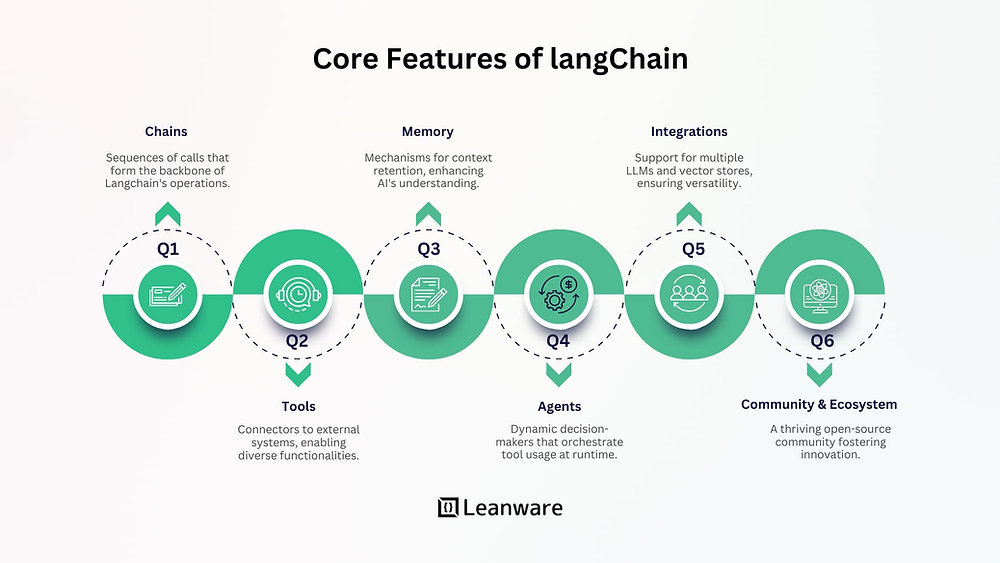
LangChain is a framework for building applications with large language models. It provides abstractions for prompts, chains, agents, memory, and tool integration.
You can connect LLMs to databases, APIs, search engines, and other services. LangChain handles the orchestration layer between your application and language models.
CrewAI builds on top of LangChain. It focuses specifically on multi-agent systems where different agents have defined roles and collaborate on tasks. Instead of building agent interactions from scratch, CrewAI provides patterns for coordinating teams of agents.
The relationship matters. CrewAI uses LangChain's components under the hood. It's not an alternative to LangChain but a layer on top that enforces specific patterns.
Why This Comparison Matters for Modern AI Systems
LLM applications often require more than a single model call. Some tasks need multiple specialized agents to coordinate, maintain context, and handle distinct steps. LangChain lets you assemble these workflows with full flexibility. CrewAI adds structured coordination for multi-agent setups.
So, comparing both helps you understand when full control is necessary and when built-in orchestration patterns make sense.
Architectural Foundations
LangChain is built for flexible, composable pipelines. CrewAI is built to coordinate multiple agents with clear roles and communication.
LangChain: Modular Chains, Graphs & Tool Integration
LangChain organizes around chains and agents. A chain connects multiple steps in sequence. An agent makes decisions about which tools to use based on input. You combine these primitives to build complex workflows.
LangGraph extends LangChain with state machines and cyclical flows. Traditional chains run linearly. LangGraph lets you define graphs where execution loops back based on conditions. This matters for applications where agents need to retry, refine, or branch based on intermediate results.
The modular design means you pick components as needed. Use LangChain's prompt templates without using its agents. Use agents without chains. Swap one LLM provider for another without rewriting application logic.
CrewAI: Role-Based Multi-Agent Collaboration
CrewAI structures agents around roles and tasks. You define agents with specific capabilities and goals. Tasks get assigned to agents. Agents communicate to complete those tasks.
A simple example: one agent researches information, another analyzes it, a third writes a summary. CrewAI handles the communication protocol and task delegation. You define what each agent does and how they interact.
This structure reduces boilerplate for multi-agent systems. You don't build communication patterns from scratch. The trade-off is less flexibility. CrewAI expects you to work within its role-based model.
Core Capabilities & Design Philosophy
Flexibility & Customizability (LangChain)
LangChain doesn’t enforce workflow patterns. You can build a simple chain or a complex agent choosing between multiple tools. Custom memory, unusual orchestration, or specialized integrations all fit naturally.
The downside: more code. You handle memory, error handling, and agent coordination yourself. Nothing is pre-configured.
Structured Orchestration & Role Specialization (CrewAI)
CrewAI enforces patterns for team-like workflows. Each agent has a role, background, and goal. Tasks flow between agents automatically according to rules you define.
This approach works when specialized agents need to collaborate. It’s less suited for custom control flows or non-standard interactions.
Performance, Scalability & Complexity
Parallelism, Execution, and Scaling (LangChain)
LangChain supports async operations: multiple LLM calls, API requests, and database queries run in parallel. LangGraph gives fine-grained control over retries, conditional branching, and execution paths.
Scaling requires understanding workflow bottlenecks. LLM latency, database queries, and external API calls each affect performance differently.
Coordination Overhead & Scaling Challenges (CrewAI)
Multi-agent coordination introduces overhead. Agents communicate and track tasks, which can slow simple workflows.
Adding more agents doesn’t automatically improve throughput. Coordination becomes the bottleneck. CrewAI excels when agent specialization adds clear value, but for simpler tasks, a single agent can be more efficient.
When LangChain Works Best
LangChain is best when you need full control over workflows and agent logic:
- RAG pipelines: Retrieve and feed relevant document chunks to an LLM.
- Chatbots with memory: Track context using buffer, summary, or vector memory.
- Custom agent workflows: Control tool selection and decision logic.
- Data pipelines: Chain API calls, transformations, and LLM steps with retries.
When CrewAI Works Best
Use CrewAI for coordinated, role-based agent tasks:
- Research & analysis: Agents search, evaluate, synthesize, and write.
- Content creation: Agents handle research, outlining, writing, editing, fact-checking.
- Simulation & planning: Role-based agents collaborate on complex decisions.
Integration & Hybrid Strategies
LangChain and CrewAI can work together in the same system. CrewAI agents can use LangChain tools directly, while LangChain agents can delegate multi-step tasks to a CrewAI crew. This lets you use LangChain for flexible orchestration and CrewAI for specialized multi-agent collaboration, applying each where it provides the most value.
Getting Started
Choose based on the workflows and complexity of your project.
LangChain works well when you need precise control over agents, orchestration, and tool integration. Suitable for RAG systems, chatbots, and custom pipelines.
CrewAI works best when tasks involve multiple specialized agents coordinating with defined roles. Ideal for research workflows, content pipelines, or simulations.
If you know LangChain, it’s easy to start even for multi-agent setups. CrewAI simplifies multi-agent coordination but expects you to follow its structured approach.
You can connect with our experts for consultation and support to implement and optimize LangChain or CrewAI in your projects.
Frequently Asked Questions
Is CrewAI Better Than LangGraph?
They solve different problems. CrewAI coordinates multiple role-based agents. LangGraph builds stateful workflows with conditional logic and cycles. Your use case determines which fits better.
For multi-agent systems where agents have distinct roles, CrewAI provides better abstractions. For complex workflows requiring precise control over state and execution paths, LangGraph offers more flexibility.
Can I Use LangChain With CrewAI?
Yes. CrewAI is built on LangChain. Every CrewAI agent uses LangChain components internally. You can use LangChain tools, memory modules, and integrations directly in CrewAI agents.
You can also use CrewAI crews as tools within larger LangChain applications. The frameworks complement each other rather than compete.